6.10 — Pre-norm vs post-norm Transformer block
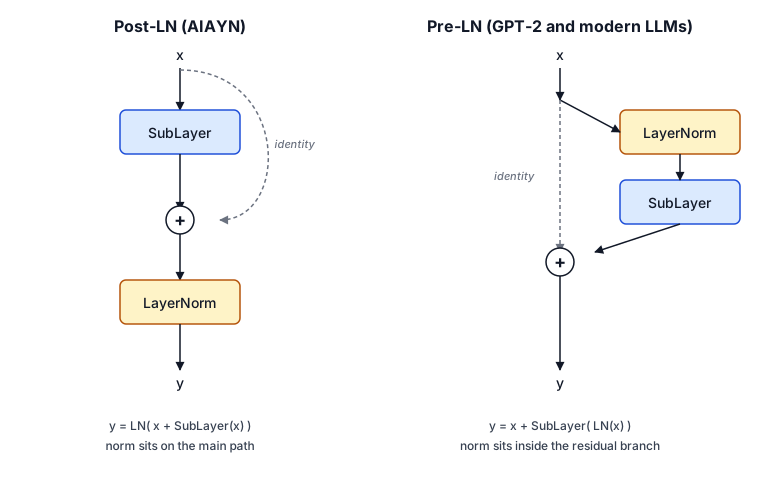
Goal: Compare post-LN (original AIAYN) and pre-LN (GPT-2 onward) block diagrams; understand why pre-norm trains stably without warmup, what it changes in the residual stream, and why every modern LLM is pre-norm.
1. Why this session exists
6.9 gave us residual connections; 3.8 gave us LayerNorm and RMSNorm. A Transformer block uses both, but a small architectural choice — where the norm sits relative to the residual — has outsized consequences. The original AIAYN block puts the norm after the residual addition (post-LN); GPT-2 and every LLM since put the norm before the sub-layer (pre-LN).
The two diagrams differ by the position of one box, but they train very differently:
- Post-LN. Stable up to ~12 layers; needs a learning-rate warmup; gradient norms blow up near the input on deep stacks; sensitive to initialisation.
- Pre-LN. Trains stably at 96+ layers; no warmup required; gradient norms are well-behaved across depth; tolerates a wider learning rate range.
This session shows both block diagrams, derives why pre-norm preserves the identity path of 6.9 while post-norm breaks it, and surveys the evidence that every modern LLM (GPT-2/3/4, LLaMA, Mistral, Qwen, Gemini, Claude) uses pre-norm. We will be writing pre-norm blocks for the rest of the course.[1, 3]
2. The two block variants
Let stand for either the multi-head attention sub-layer (6.4) or the FFN sub-layer (6.8). Both map , and both are wrapped in a residual.
2.1 Post-LN (original AIAYN)
The norm acts after the residual addition. In a Transformer block this looks like
This is the diagram in Attention Is All You Need §3.1 (Vaswani et al., 2017[2]) — the one usually drawn with "Add & Norm" boxes after each sub-layer.
2.2 Pre-LN (GPT-2 and modern LLMs)
The norm acts before the sub-layer, inside the residual branch. Per block:
Same residuals, same sub-layers; the norms have moved one box. A final is usually applied to before the output projection — so that the last "raw" residual stream is rescaled exactly once at the end.
3. The residual stream argument
The difference between post-LN and pre-LN is best read through the residual stream of 6.9 §5.
3.1 Pre-norm preserves the identity path
Stack pre-LN blocks. Write for the -th residual branch. Then
This is the residual-stream formula. The Jacobian contains the identity term from 6.9 §3.2:
The gradient flows un-attenuated along the skip path. The norms sit inside each residual branch — they affect but they do not touch the identity term. Pre-norm is the same gradient story as plain residual.
3.2 Post-norm breaks the identity path
Stack post-LN blocks. Define , so . The Jacobian is
The norm's Jacobian is not identity. LayerNorm subtracts the mean and divides by the standard deviation, with a learnable scale that at initialisation is . As shown by Xiong et al. (2020)[6] — see §5 — for ,
which has spectral norm typically less than , and which kills two specific directions of the input: the all-ones direction (mean subtraction) and the input's own normalised direction. Stacking such factors brings back the multiplicative-collapse problem of 2.9 — the precise thing residual connections were meant to avoid.
In short: post-LN puts a non-identity Jacobian on the main path of every block, so the multiplicative chain rule resumes its old behaviour.
4. Empirical consequence: warmup and depth
4.1 The warmup problem of AIAYN
The original AIAYN paper specifies a learning-rate warmup of steps for -layer encoder/decoder pairs. The reason is the §3.2 gradient instability: at , with random initialisation, the gradient magnitudes near the input of a deep post-LN stack are very different from those near the output, and a small initial learning rate is needed to let the parameter scales equilibrate. Without warmup, post-LN models diverge on the first few hundred steps.
This was tolerable at 6 layers. At 12 layers (BERT-base) it was already annoying. At 96 layers (GPT-3) it would have been a constant tuning burden — and that is if it converged at all.
4.2 Pre-LN removes the warmup
Empirically — and provably, via the analysis below — pre-LN models train stably from step 1 with any reasonable learning rate. Constant-LR training works, and a cosine schedule (3.7) or WSD (3.7) without warmup converges to within a couple of percent of the warmed-up baseline. The first paper to attribute GPT-2's stability to its pre-LN choice was Wang et al. (2019)[5], Improving deep Transformer with depth-scaled initialization and merged attention (arXiv:1908.11365).
4.3 What about post-LN's quality at convergence?
A subtle wrinkle: on small / shallow models (≤12 layers, BERT-base, vanilla translation), post-LN trained well if you warmed up and gave slightly better validation loss than pre-LN. This is because the inner norms in pre-LN partially constrain the residual stream's geometry (every sub-layer sees a unit-norm input), which is a mild regularisation. At scale (≥24 layers) this advantage is dwarfed by post-LN's training instability, and pre-LN dominates.
The frontier-model story is unambiguous: every LLM at M parameters since GPT-2 is pre-LN, including GPT-2/3/4, LLaMA, Mistral, Qwen, Gemini and Claude. BERT (post-LN) is the last meaningfully-used post-LN model in the wild, and successor encoder models (DeBERTa-v3, modern E5/BGE) use pre-LN too.
5. Sketch of Xiong et al.'s argument
The standard reference is Xiong, Yang, He, Zheng, Xing, Zhang, Lan, Wang, Liu, On layer normalization in the Transformer architecture (2020, arXiv:2002.04745). They prove two claims under mild regularity assumptions:
Claim 1 (Post-LN gradient grows with depth at initialisation). For a post-LN Transformer of depth with random Gaussian initialisation, the expected gradient norm at the first sub-layer scales as
i.e. it grows with depth. This means deep post-LN models have gradient signals near the input that overwhelm a constant-LR optimiser — the rationale for warmup.
Claim 2 (Pre-LN gradient is depth-independent). Under the same assumptions, the pre-LN gradient norm at the first sub-layer scales as
with no depth dependence. Constant-LR training is well-posed at any .
The proofs use the residual-stream expansion of 6.9 §3.2 and the fact that pre-LN's identity path commutes with the LayerNorm Jacobian on the residual branch only. We will not redo the calculation here — Xiong et al.'s presentation is clean and short (their §3).
The lesson is the one we already saw informally: putting the norm inside the residual leaves the identity path untouched; putting the norm outside the residual rescales it. Depth-independent gradient norms follow.
6. The norm-placement rule, generalised
The same lesson recurs throughout deep-learning architecture. Whenever a normalisation operation sits on the main path between two residual stages, the multiplicative-chain-rule problem returns; whenever the normalisation sits inside a residual branch, gradient flow remains depth-independent.
This is one rule with multiple instances:
- ResNet-v1 (post-activation BN): the BN sits between two residuals on the main path → harder to train at extreme depth.
- ResNet-v2 (pre-activation BN, He et al., 2016[4], Identity mappings in deep residual networks, arXiv:1603.05027): the BN moves into the residual branch → trains to 1000+ layers with the same recipe.
- Pre-LN Transformer: the LN moves into the residual branch → 96+ layers train stably.
The pattern is structural, not specific to Transformers. The same proof template applies to any residual architecture.
7. The final layer norm
A pre-LN stack ends with one extra normalisation:
Reason: each block's residual branch normalises its input but the trunk itself is un-normalised — the residual additions cumulate without bound. As grows, drifts upward; if we projected the un-normalised directly to vocabulary logits, the softmax (and the loss) would see an arbitrary scale. One LN at the very end fixes this without disturbing the gradient story.
Equivalently: pre-LN's invariant is "every sub-layer sees a unit-norm input"; the trunk does not have to be unit-norm at intermediate layers — only the inputs to sub-layers. The final LN converts the trunk to the same standard.
8. Hybrid and exotic variants (for context)
A few architectural offsprings worth knowing the names of, mostly outside the scope of this chapter:
- DeepNorm (Wang et al., 2022, arXiv:2203.00555)[7]. A post-norm variant with carefully chosen residual scaling that trains at layers. Used in some Microsoft/Tsinghua research papers; not in current frontier LLMs.
- Sandwich-norm (Ding et al., 2021, GLM). Adds both pre-norm and post-norm. Stable but more parameters.
- NormFormer (Shleifer et al., 2021, arXiv:2110.09456)[8]. Adds an extra LN after attention output. Reduces gradient norm in deeper layers.
All build on the pre-LN baseline. None has displaced it in any frontier LLM. For the rest of this course, "Transformer block" means pre-LN with one at the top.
9. What we keep going forward
Two residual additions, two LayerNorms placed inside the residual branches, no warmup needed, depth-independent gradient norms. Next session assembles the full decoder-only stack ( such blocks, embedding + LM head + final norm) and pairs it with a guided read of Attention Is All You Need.
(a) Write out the post-LN block in pseudocode (5 lines) and the pre-LN block in pseudocode (5 lines). Identify, in each, the gradient path that bypasses .
(b) For pre-LN, derive that the Jacobian of one block factorises as . For post-LN, derive that the Jacobian factorises as . Which of these has an identity term that does not depend on ?
(c) Suppose uniformly (a rough average for a wide LN). Bound the spectral norm of the post-LN Jacobian over stacked blocks. Compare to the pre-LN bound.
(d) Read Xiong et al. (2020, arXiv:2002.04745) §3 and reproduce, in your notes, the two-line argument that the post-LN gradient grows as and the pre-LN gradient is .
(e) Argue why pre-LN requires a final before the output projection but post-LN does not.
References
- [1]
Raschka, S. (2024). Build a Large Language Model (From Scratch), Chapters 3–4. Manning. — Self-attention implementation (6.3, 6.4), causal masking (6.5), pre-norm block (6.10–6.11).
↩ - [2]
Vaswani, A., Shazeer, N., Parmar, N., et al. (2017). "Attention is all you need". NeurIPS. arXiv:1706.03762 — The Transformer paper. Scaled dot-product attention (6.2), multi-head attention (6.4), encoder–decoder cross-attention (6.3), sinusoidal positional encoding (Appendix 6.A), the FFN sub-layer (6.8), post-LN block diagram (6.10), full architecture read (6.11).
↩ - [3]
Radford, A., Wu, J., Child, R., et al. (2019). "Language models are unsupervised multitask learners" (GPT-2). OpenAI technical report. — Learned absolute positional encoding (Appendix 6.B), pre-LN variant (6.10), the architectural skeleton of every modern decoder-only LLM (6.11).
↩ - [4]
He, K., Zhang, X., Ren, S., & Sun, J. (2016). "Identity mappings in deep residual networks". arXiv:1603.05027 — Pre-activation ResNet; the structural blueprint behind pre-LN Transformer (6.10 §6).
↩ - [5]
Wang, Q., Li, B., Xiao, T., et al. (2019). "Improving deep transformer with depth-scaled initialization and merged attention" (a.k.a. learning deep Transformers). arXiv:1908.11365 — Early analysis of post-LN instability; motivation for pre-LN (6.10 §4.2).
↩ - [6]
Xiong, R., Yang, Y., He, D., et al. (2020). "On layer normalization in the Transformer architecture". arXiv:2002.04745 — Theoretical analysis: post-LN gradient grows as √L, pre-LN is O(1) (6.10 §5).
↩ - [7]
Wang, H., Ma, S., Dong, L., et al. (2022). "DeepNet: Scaling Transformers to 1000 layers" (DeepNorm). arXiv:2203.00555 — Stable post-norm variant via residual scaling (6.10 §8).
↩ - [8]
Shleifer, S., Weston, J., & Ott, M. (2021). "NormFormer: Improved transformer pretraining with extra normalization". arXiv:2110.09456 — Additional norm placements for deeper models (6.10 §8).
↩